

Trade Syndication · Volatility spikes · Thursday, Oct 8
Volatility spikes on Thursday, Oct 8: Ethereum 7.8× a normal hour
The hours that broke furthest from normal, measured against each market’s own normal hour.
For every market we cover we find its busiest hour of the day and set it against its normal hour: the median one-hour range of its last 20 sessions. A spike is an hour of three times normal or more. These are the biggest on Thursday, Oct 8, with any scheduled news around them and what the market did in the two hours after. Times are New York time.
- ⚡ Ethereum 4.03% in an hour (7.8× normal)
- ⚡ Nasdaq 100 1.48% in an hour (6.7× normal)
- ⚡ Bitcoin 2.20% in an hour (5.6× normal)
- ⚡ Solana 4.02% in an hour (5.5× normal)
- ⚡ S&P 500 0.68% in an hour (4.8× normal)
1. Ethereum: a one-hour burst 7.8× its normal hour
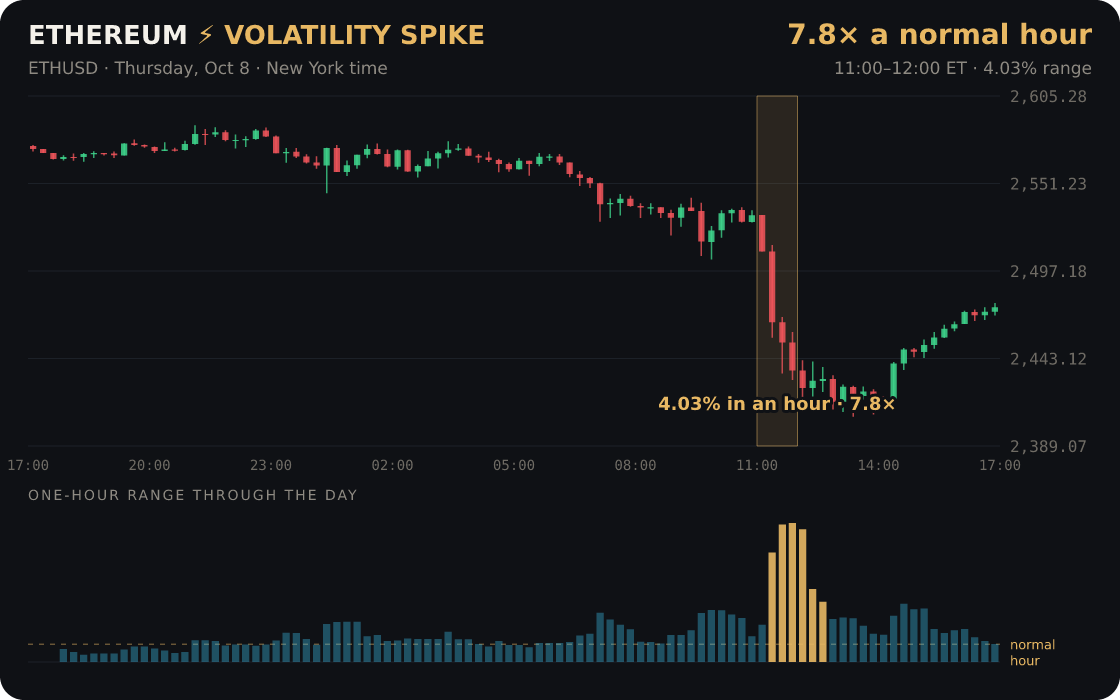
| One hour | 4.03% (11:00 to 12:00 ET) |
|---|---|
| A normal hour | 0.52% (median of 20 sessions) |
| This hour | 7.8× (a normal hour) |
Between 11:00 and 12:00 ET on Thursday, Ethereum traded a 4.03% range, 7.8× a normal hour for it (about 0.52%).
There was no scheduled high- or medium-impact news for it at the time.
It moved −3.79% in that hour, then kept going: another 0.72% over the next two hours.
2. Nasdaq 100: a one-hour burst 6.7× its normal hour
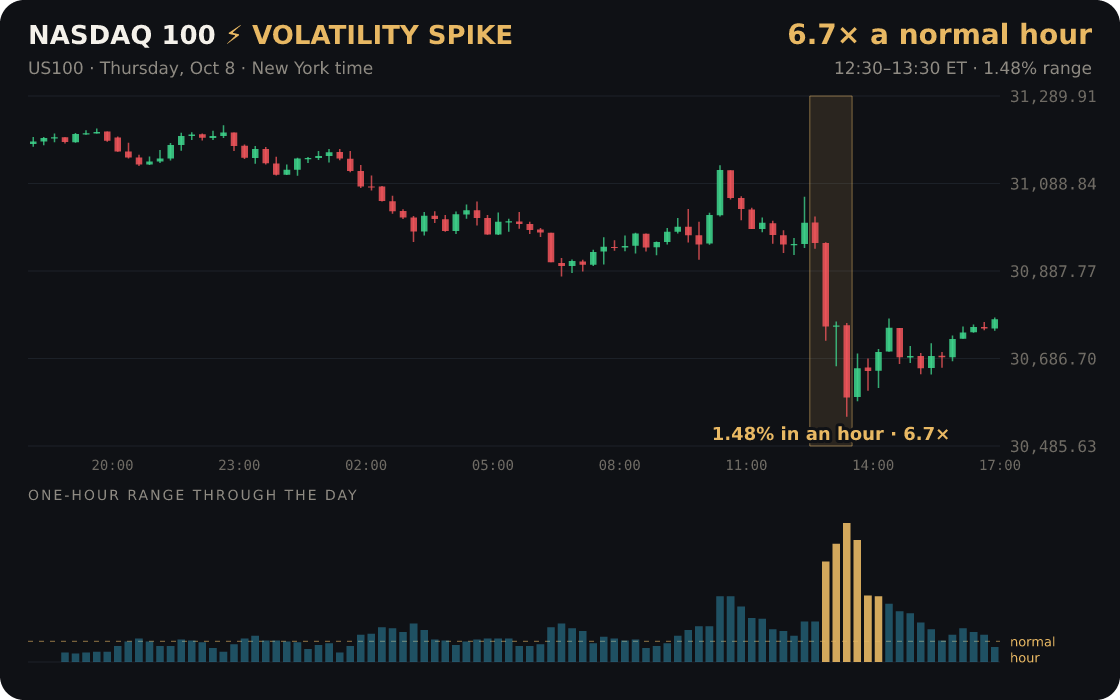
| One hour | 1.48% (12:30 to 13:30 ET) |
|---|---|
| A normal hour | 0.22% (median of 20 sessions) |
| This hour | 6.7× (a normal hour) |
Between 12:30 and 13:30 ET on Thursday, Nasdaq 100 traded a 1.48% range, 6.7× a normal hour for it (about 0.22%).
There was no scheduled high- or medium-impact news for it at the time.
It moved −1.30% in that hour, then gave back 0.31% over the next two hours.
3. Bitcoin: a one-hour burst 5.6× its normal hour
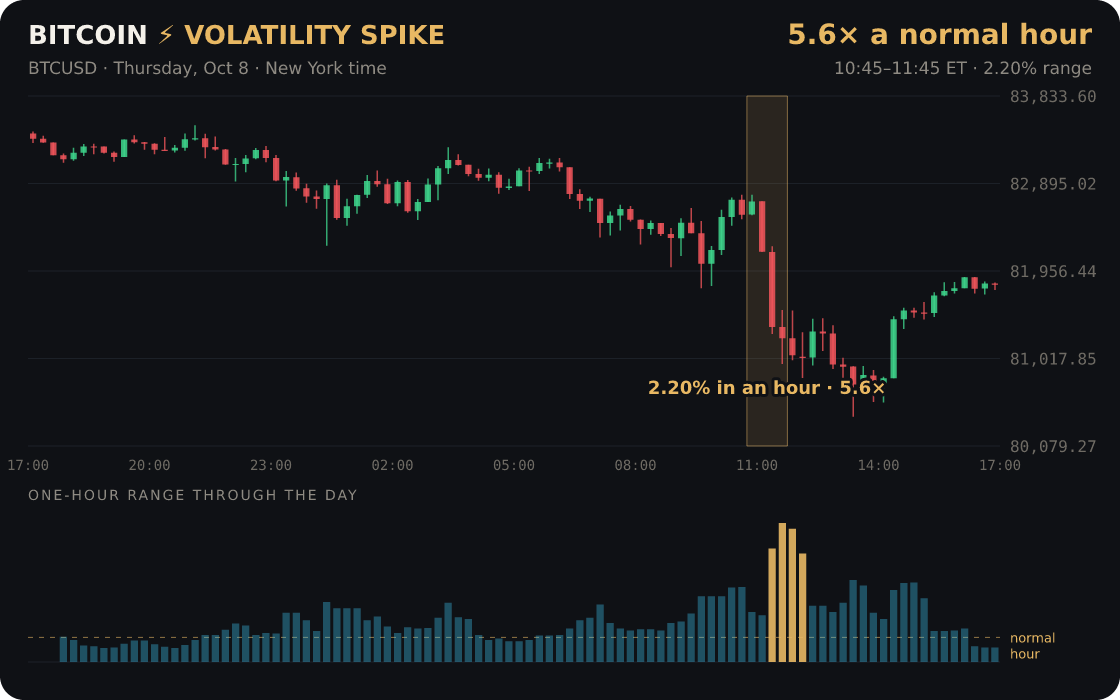
| One hour | 2.20% (10:45 to 11:45 ET) |
|---|---|
| A normal hour | 0.39% (median of 20 sessions) |
| This hour | 5.6× (a normal hour) |
Between 10:45 and 11:45 ET on Thursday, Bitcoin traded a 2.20% range, 5.6× a normal hour for it (about 0.39%).
There was no scheduled high- or medium-impact news for it at the time.
It moved −1.61% in that hour, then kept going: another 0.49% over the next two hours.
4. Solana: a one-hour burst 5.5× its normal hour
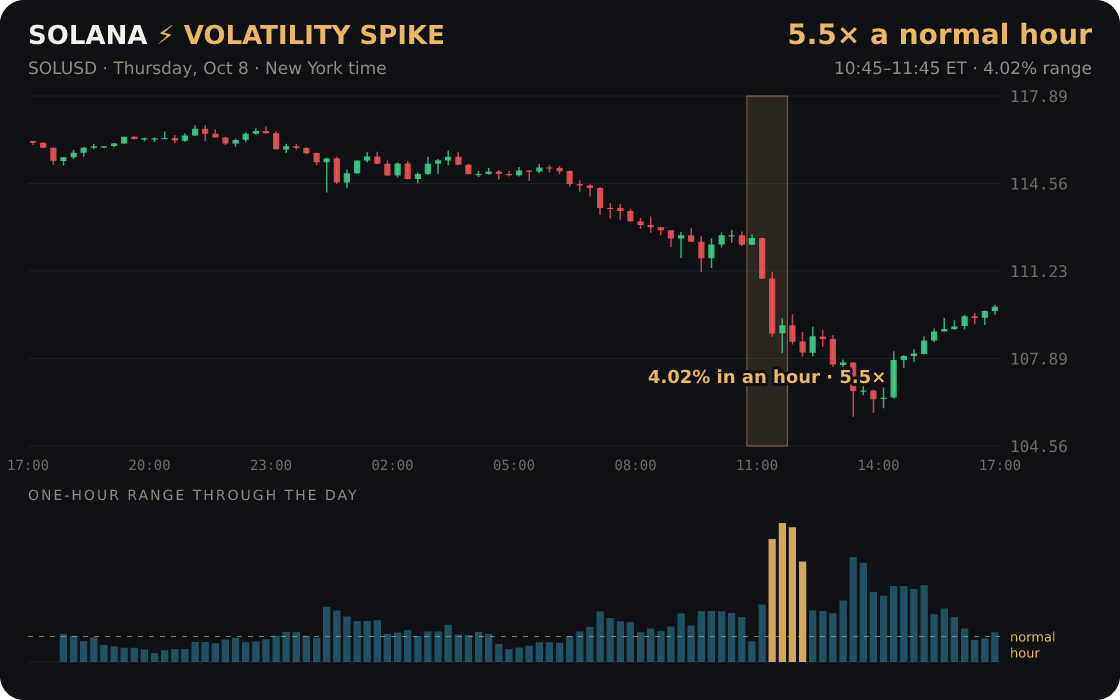
| One hour | 4.02% (10:45 to 11:45 ET) |
|---|---|
| A normal hour | 0.74% (median of 20 sessions) |
| This hour | 5.5× (a normal hour) |
Between 10:45 and 11:45 ET on Thursday, Solana traded a 4.02% range, 5.5× a normal hour for it (about 0.74%).
There was no scheduled high- or medium-impact news for it at the time.
It moved −2.74% in that hour, then kept going: another 2.28% over the next two hours.
5. S&P 500: a one-hour burst 4.8× its normal hour
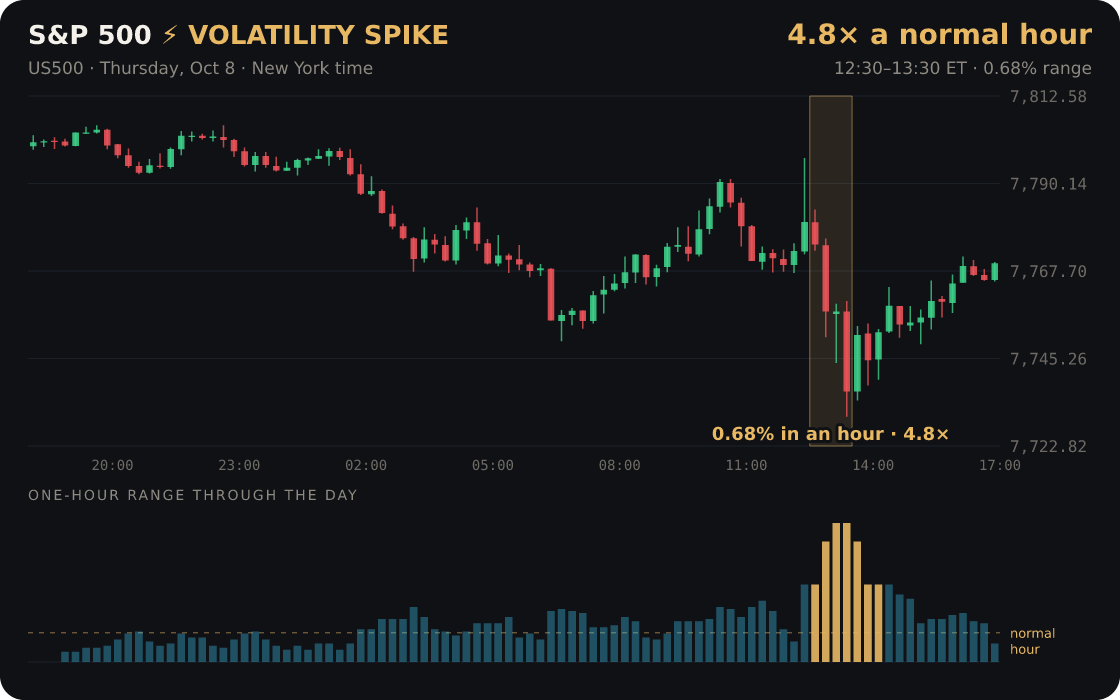
| One hour | 0.68% (12:30 to 13:30 ET) |
|---|---|
| A normal hour | 0.14% (median of 20 sessions) |
| This hour | 4.8× (a normal hour) |
Between 12:30 and 13:30 ET on Thursday, S&P 500 traded a 0.68% range, 4.8× a normal hour for it (about 0.14%).
There was no scheduled high- or medium-impact news for it at the time.
It moved −0.56% in that hour, then gave back 0.30% over the next two hours.
Bursts like these are when the size behind a trade matters most. You take the trade. The desk puts its own capital behind it, steps up as it proves itself, and pays you 90% of what that capital makes.
Trade the next move with the desk behind you →
Prices are from our market data feed; times are New York time (ET), and a day runs New York 17:00 to 17:00. This is market information, not investment advice or a recommendation to trade. Past moves do not predict future ones, and trading involves risk of loss.